
Don't Saddle Your Future Self with Tasks
Don’t Saddle Your Future Self with Tasks
It was a Monday when I should have been able to get a lot done. I had important work to do, and my boss was going to leave me alone all week. Ideal conditions, really.
Still, I felt hemmed in. Overwhelmed, unsure what to do, somehow foggy. There was stuff lying around the flat. Five displays and three notebooks stared at me from my desk. The plants needed watering. My lists held tasks, ideas, books, bookmarks and things I wanted to do. All things I meant to get around to someday. Apparently, someday was now.
I had time. But it already felt spoken for.
At times like that, it’s tempting to blame other people. The boss, the meetings, the family, the constant requests. Someone always wants something. But that Monday I couldn’t really make that claim. The person who had filled my week was me. More precisely: my past self.
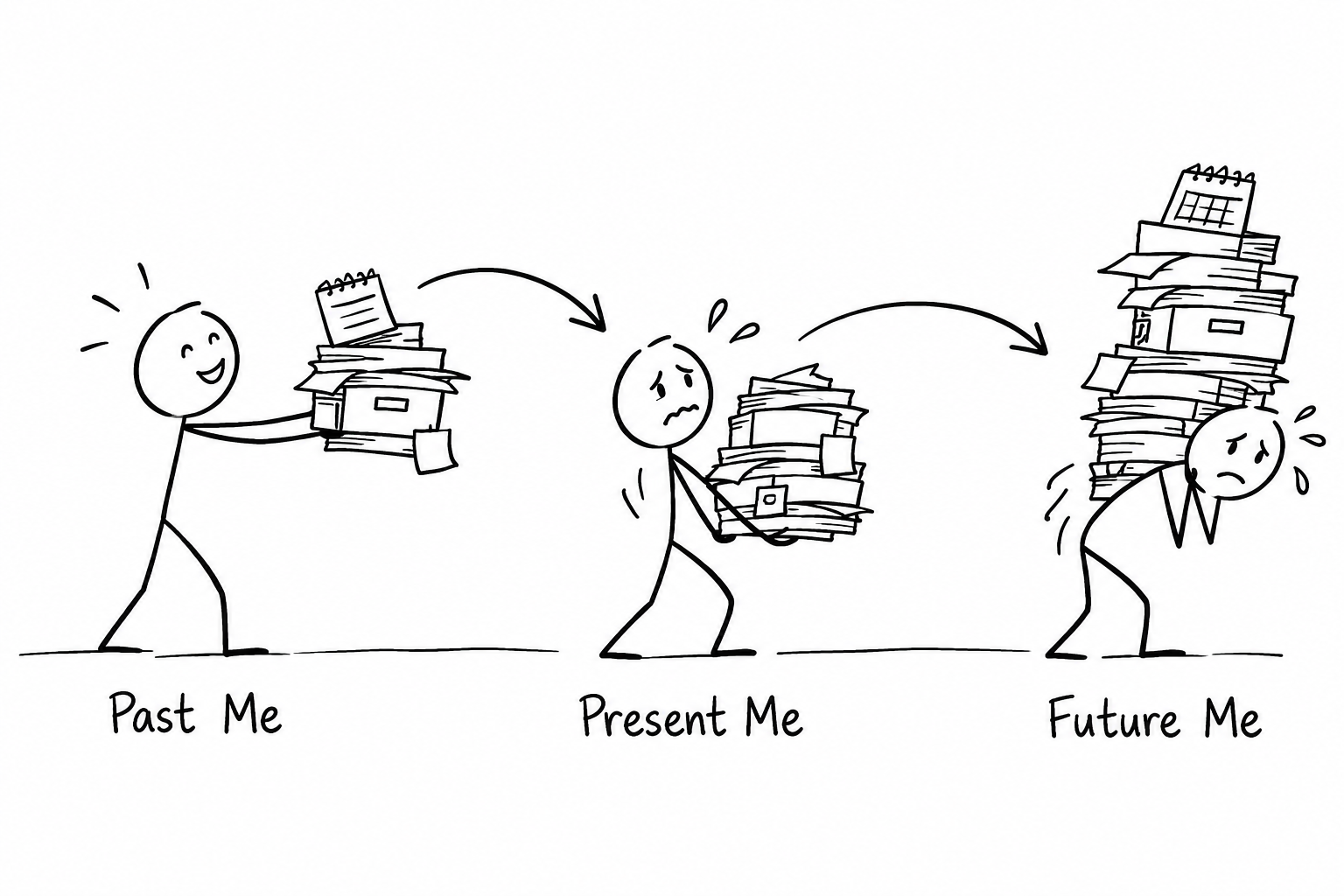
My theory is that we create a good deal of the pressure that hems us in. We keep loading tasks onto our future selves, then wonder why we have so little room to move. If we want that to change, we have to pay attention today to what we leave them.
I’ll do it later
I use the German word aufnacken as a reminder to myself: stop saddling your future self with things that only constrain it. I make a decision now, but my future self has to do the work. I get the relief immediately. The effort comes later.
The obvious example is a task I put off until next week. I leave an email unread so I can find it again. An idea goes on a list. An interesting article goes into a read-it-later app. For the moment, I can breathe. At least I’ve captured it all.
But none of it is done.
Meetings make this especially clear. Do all the appointments we complain about really come from other people? Or do we schedule some ourselves because we don’t yet know how to deal with a problem? Unclear responsibilities, an unfamiliar question, an unpleasant decision: let’s get together next week. Invite three colleagues, block an hour. Out of my head for now.
Then next week we sit there and wonder why, once again, we have no time for the work that matters.
Timeboxing follows the same pattern. I make an appointment with myself. Today’s me decides what Thursday’s me will work on at 2 p.m. The more precisely I schedule the week, the less there is left to decide on Thursday. I’ve already planned away my freedom to follow my energy, an important new question or a good idea.
Of course, we often postpone something because there really is no time right now. But why is there no time? Sometimes because our past selves already left us too much to do. So we pass the next task along. A chain in which each self burdens the next and buys itself a little breathing room.
And somewhere in that chain I’m standing there on Monday thinking: who landed me with all this?
The hidden costs of an urban jungle
What bothers me even more are the commitments we take on without recognizing them as tasks handed to the future.
I buy beautiful plants for my urban jungle. The flat looks better and I’m pleased. But who’s going to water them for years to come? Who will repot them and deal with pests? My future self. Sunday is watering day at my place, and I regularly get annoyed that I have to spend another hour watering and tending the plants.
That’s the difference from a single postponed task: I permanently gave away part of my Sundays. When I bought the plant, I mostly saw the plant. The recurring work came free of charge.
These days I don’t replace every plant that dies. I’m glad when there are fewer of them, too.
A lot of purchases work the same way. A bigger flat needs cleaning. A holiday home needs looking after and using. After all, you’ve bought it. And suddenly what you own even shapes where you spend your holidays. What feels like another option when you buy it can narrow your choices later.
The smaller version happens every day. I use a dish and leave it out. I leave things lying around instead of putting them back. The clean laundry stays in the basket. I’ll do it later.
Congratulations: later, the flat is full of it.
Each decision on its own seems trivial. Together they create a space that demands attention. For me, it can get to the point where I can barely start my most important task. Everywhere I look, I see things that need doing first, and I want to clear the decks completely.
Digital clutter does the same thing. A hundred saved articles, unread books, lists full of ideas. Eventually it all starts to feel like work. Even my free time has a backlog.
Shaping the future
Take this thought to its extreme and you might say: then I just won’t take on any commitments. No children, no relationships, no plans. As little as possible for my future self to deal with.
That’s where I draw a line. Children take an enormous amount of time, but they can also bring immense happiness. Friendships need tending, and these are the very people I want to spend my life with. Plants can bring someone joy every week, too. In that case the time spent caring for them is well spent.
The question that matters to me is: do I want to live the life that comes with this decision?
For an urban jungle, that means: do I want to care for plants, or do I mainly like the idea of a green flat? For a holiday home: do I want to keep going there and looking after it? For a new hobby: do I actually want to do it, or do I like the idea of being someone who does?
That helps me tell the difference between consciously shaping my future and casually leaving work for my future self.
Planning has its place, too. Without a direction of my own, I can easily end up at the mercy of events and other people’s plans. It helps to know: this project matters over the next few days. I want time for it. But that needn’t become a weekly plan that dictates every hour.
I want to trust my future self to decide, when the time comes, how to pursue that direction.
Leave your future self some room
For me, this changes how I think about productivity. I want to judge my actions more by how much room they leave my future self.
Decluttering the flat takes time and energy today. Afterwards, fewer things are lying around, needing care or demanding my attention. Ending a needless commitment can be uncomfortable. But it frees up time later. Finishing a small task takes something off my future self’s plate.
I see these as investments. I do something today so I have more freedom to shape tomorrow. Fewer loose ends, less upkeep, less time already spoken for.
It also means letting opportunities pass. I don’t have to read every interesting article. Act on every idea. Put every book on a list. An opportunity doesn’t automatically become more valuable because I save it for later.
So here’s an experiment: for a few days, pause the systems you use to organize ever more work for later. Idea lists, read-it-later collections, minute-by-minute daily plans. You don’t have to delete anything. Existing commitments and necessary appointments still stand. But, for a while, try not to keep adding new things.
If you come across an interesting article, read it now or let it go. If an idea comes to you that you want to try right away and you have the time, try it. Otherwise, it can disappear again. If someone asks you to take on an extra task you can’t handle right now, try saying no for once instead of automatically offering up your future self.
And for the little things at home: tidy up after yourself. Finish something while you’re already doing it. For tasks that take under five minutes, “do it now” can be a useful rule of thumb. You don’t have to interrupt important work for it. But you can put away the glass you just used.
Perhaps you’re thinking: if I have to do everything right away, I’ll never get anything else done. That’s a fair objection if just as much new work keeps coming in. That’s why leaving things out is essential. Take on less, collect less, start less. Then there’s more time to finish things as you go.
I want another Monday when I can turn to my most important task without first clearing up what the previous week left behind. I can do something today to make that possible.
My future self should still get to decide what to do with its day.